


What Is Functional Movement?
Functional movement is simply how well your movement works for you — without discomfort, stiffness, or limitation.
Repetition — whether from training, occupation, stress, or inactivity — shapes how the body distributes tension and load. Some adaptations enhance performance and resilience. Others create imbalance, reduce joint integrity, and limit coordinated strength.
Over time, these compensations change how your body handles movement. You may still be able to move, but it requires more effort and may begin to feel uncomfortable. Some areas start working too hard, while others stop contributing properly.
Functional movement identifies those limitations and restructures mechanical organization at the source. The goal is not to chase symptoms, but to improve how the body manages load across joints, connective tissue, and muscular systems.
The objective is improved mechanical efficiency — not simply increased flexibility.
Tradition + Mechanics
This methodology draws from two disciplines:
Yoga contributes control and awareness — the ability to regulate breath, move with precision, and transition with intention.
Biomechanics contributes structural clarity — an understanding of joint loading, tissue tolerance, force direction, and progressive adaptation.
Together, they form a system where mobility and strength develop concurrently rather than in opposition.
The aim is not intensity.
The aim is structural capacity.
Key principles informing assessment and progression:
- Breath mechanics
- Core integration
- Load tolerance
- Movement variability
- Neuromuscular coordination
These guide how patterns are evaluated, sequenced, and progressed.


Precision Movement Therapy
Reclaim Efficient Patterns
The body reflects its history of use. Repetition becomes organization.
Private sessions focus on:
- Identifying compensatory strategies
- Restoring joint articulation where restriction exists
- Reinforcing stability where control is insufficient
- Integrating strength into newly available range
Corrective mobility is paired with progressive loading so that new patterns are not only accessed — but retained.
This work is particularly relevant for individuals experiencing:
- Persistent tightness unresponsive to passive stretching
- Transition from physiotherapy back to strength training
- Desk-dominant postural adaptations
- Athletic performance plateaus
- Chronic stress-related muscular bracing
Precision is prioritized over volume. Stability precedes intensity.
What Changes
Clients rarely describe dramatic shifts. Instead, they report measurable improvements in efficiency:
- Increased joint range without destabilization
- Reduced baseline muscular tension
- Postural stability without constant correction
- Improved breath depth under load
- More coordinated strength expression
These outcomes reflect improved force distribution and neuromuscular organization — not simply increased flexibility.


Workshops, Trainings and Retreats
Prepare to be Transformed
Elevate your understanding and skills through our diverse range of workshops, continuing education courses, and rejuvenating retreats. Tailored to deepen your practice, each event is meticulously crafted to explore specific themes, enriching both your knowledge and teaching proficiency or personal growth. Our offerings span various durations, from half or full-day workshops to week-long intensive training and ongoing series, providing flexibility in both time and location throughout the year.

15-Hour Experiential Anatomy and Myofascial Release
Next Course Date: Fall 2025
Location: Nusa Lembongan, Bali, Indonesia
This course can be hosted as a stand alone or it can be added into any 200 or 300 YTT.
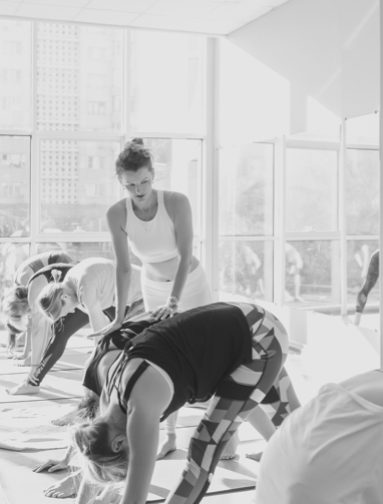
Join Danielle Gilmour, renowned yoga teacher on Yoga International for an experiential and engaging breakdown of the human body as it relates to the practice of yoga. You won’t just sit there and take notes; you will learn how to directly apply this essential information to your practice.
This course is designed so students retain what you learn by examining and feeling key anatomical landmarks in your own body. When we integrate anatomical knowledge experientially, we develop an inspired and organic ability to communicate a new depth of understanding. As we work our way through the different areas of the body, we then explore further with myofascial release and corresponding anatomy-focused yoga classes.
Each lecture is broken down and referenced in the Yoga Anatomy Training manual. The manual has ample room for note taking and comes complete with anatomical diagrams, and further simplifies the complex system of the human body including bones, ligaments, fascia, tendons, and more, in an easy to digest fashion.
Through studying advanced integrative anatomy in this course, we cover all the superficial mover muscles and the deep stabilizing muscles, how the myofascial network of the body ‘connects the dots’. After every group of muscles, we palpate the muscle so you can actively find the origin, insertion and differentiate the muscles when grouped together. Followed by myofascial discovery and release, ending with an asana practice focused on targeting and cueing for the specific muscle groups.
Having a strong foundation and understanding of how the muscles work will provide you with tools to teach or practice with more confidence and clarity.


100-Hour Sequencing and Experiential Anatomy
Next Course Date: Fall 2025
Location: Nusa Lembongan, Bali, Indonesia
In this 100-hour course you will learn how to artistically communicate with students to guide them through yoga classes. Create theme-based unique programs that are deeply layered with anatomy and experiential knowledge. Through the asana practices, you will build a three-dimensional library of language and imagery that will spark new realizations in your students.
Asana Sequencing and Inspired Communication
Communication is like conducting a symphony with our words. In order for everyone to play in harmony, we must have a clear internal vision of what we’re trying to convey. We build and clarify this internal vision through our own embodied experience, which we can then translate and transmit to our students through our cueing. From this anchor, we can teach with greater depth, potency, creativity, and spontaneity.
Without the support of actualized experience, teaching can remain flat and dispassionate.
Sequencing will be a deep exploration and uncovering of the truths that are born from and within your personal practice. In this 100-hour journey, you will engage in concentrated studies in sequencing and theming. By positioning these technical studies within a greater experience of practice, you will integrate this understanding and be able to act as a transmitter of the teachings.
Experiential Anatomy
Why do you need, or want more anatomy?
Studying anatomy is about more than learning the muscles and bones; it is about recognizing our own holistic, multi-dimensional embodiment. When we integrate anatomical knowledge experientially, we develop an inspired and organic ability to communicate a new depth of understanding.
A deeper understanding of how the body works and functions as a community of muscles firing together allows you to have intelligent sequencing and a conversation with students’ bodies to better guide them through their journey in your class.
Through studying advanced integrative anatomy in this course, we cover all the superficial mover muscles and the deep stabilizing muscles; and how the myofascial network of the body “connects the dots” and inspires strength and grace.
After every group of muscles, we palpate the muscle so you can actively find the origin, insertion and differentiate the muscles when grouped together. This is followed by myofascial discovery and release, ending with an asana practice focused on targeting and cueing for the specific muscle groups. Once something has been felt and digested from within, this information can develop potency and be integrated into wisdom.

By the End of This 100-Hour Module You Will Be Able To:
- Feel confident teaching, having 10 hours of teaching group classes
- Target an area of the body for myofascial release
- Have 6 targeted asana programs for specific body areas
- Dive deep into the layers of your personal practice
- Design and build empowering sequences
- Be confident in your teaching style
- Skillfully and intuitively pace your class teaching for maximum student experience
- Create graceful and safe transitions to seamlessly integrate the class into one continuous flow
- Cultivate the techniques necessary to hold students in the practice space skillfully, seamlessly, and intuitively
- Develop your authentic and empowered teaching voice
- Experiment with a variety of practices to develop an experiential understanding of each practice’s effects
- Create powerful and inspirational thematic journeys from a place of personal connection and intuition
- Find greater trust in your own inner wisdom and gain confidence in your teaching
- Cue the physical body in asana, from the visceral to the subtle
- Develop your own internal library of metaphors, imagery, and creative language that you can draw from to expand your teaching and cueing
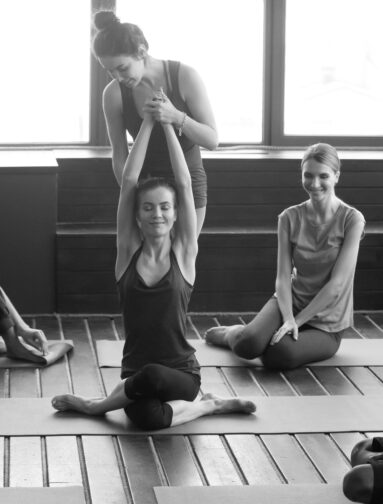
- Use integrative hands-on assists that work with the intelligence of the body to help students integrate the actions of the pose
- Intelligently cue students in order to help them self-adjust
- Enrich and advance your personal yoga through daily immersive practices
- Deepen your connection to your own voice, empower your presence, and hold space as a teacher
- Be ready for job auditions